Note-taking Tips
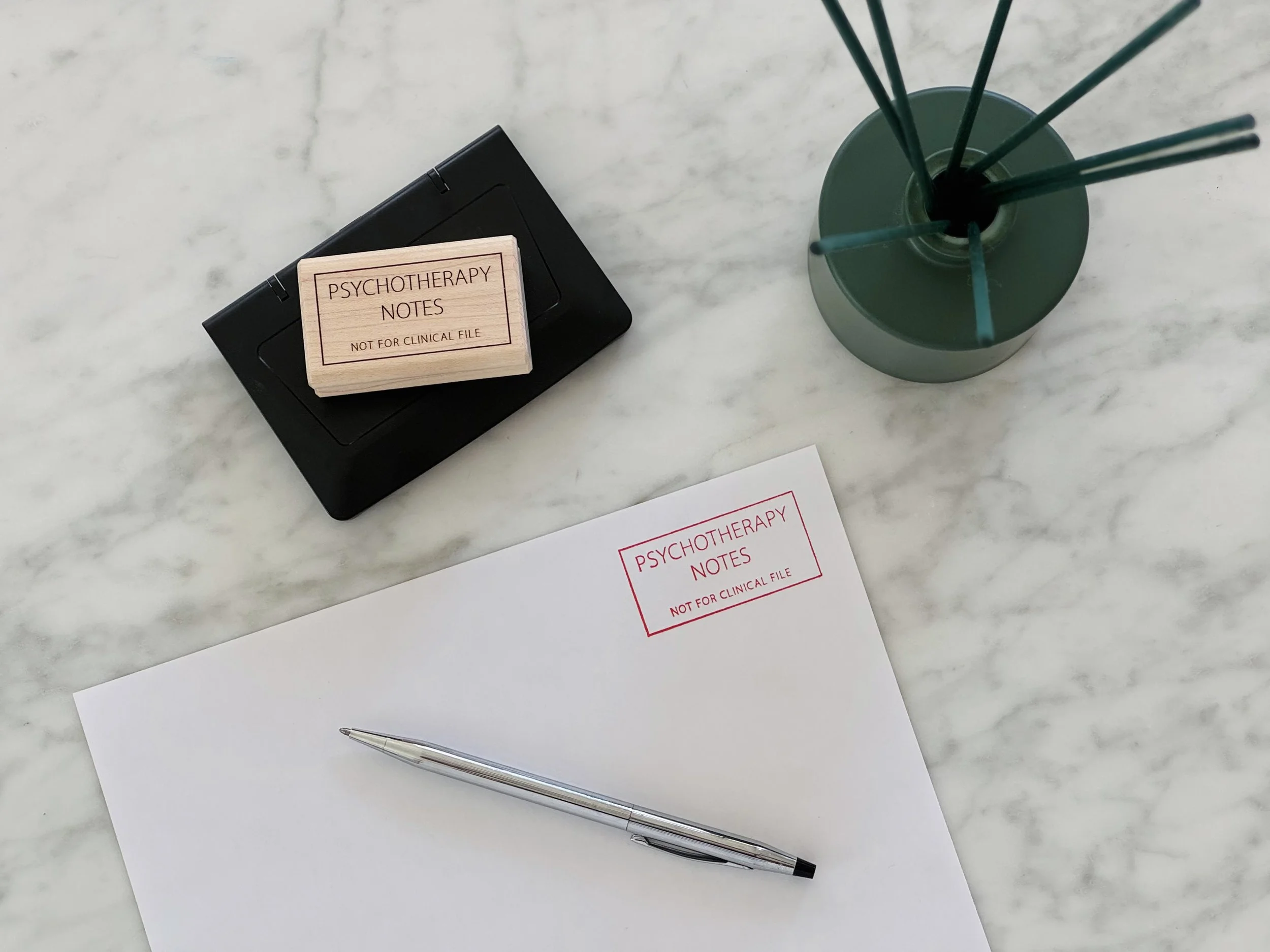
Somehow I’ve never had note-taking anxiety. If that immediately rules me out as someone you’ll listen to on how to take notes that are both clinically sound for the client file and helpful for you in session and out of session - I promise, no feelings hurt. Besides, how could I get my feelings hurt if I don’t really care that much about notes anyway? Maybe I should rephrase that. It’s not that I don’t care - it’s more that I can’t care. I need my notes to be easy and solid so I can put my energy toward being present in session and getting home quickly after session. Don’t we all just want to be home with our people or fur-babies?
I think of notes in two different ways - in session and outside of session. Let’s break it down together, starting with out-of-session notes.
Part of the reason I have little anxiety is because I feel good about my template. I built a clinical template, embedded in my EHR that I can complete right after my session. When I used to have back to back sessions, I could complete a note between sessions in 2 minutes and leave as soon as my last session was done. How? Let me show you:
Outside of Session - Session Note Template
I have 3 templates to choose from in my EHR: EFT for couples, individuals and families. Each template has a host of checkboxes. The dropdowns under each category give me options that I can click based on what step I did in the corresponding stage. After that, I can choose other clinically relevant items based on where my client is on the map and what I did that session.
Checkboxes for everything:
Step and stage of the overall EFT map
Specific interventions used
Treatment plan progress
Mental/behavioral status (problematic symptoms or presentations)
This template is one that I feel confident would pass as thorough and clinical without giving narration that could be misconstrued if audited or reviewed in a legal or ethics context.
All I’m doing is checking boxes. I rarely write anything. Why? I don’t need to. The only reason I would write something is if I needed to document something for ethical/legal reasons (suicidal ideation, conversations about switching therapists or ending therapy, referrals for anything outside of scope of practice like a psychiatrist, etc).
The content of the session, client words, themes - all of this I can glean from my psychotherapy notes. I purposefully leave it out of the clinical file because I want the clinical file to be as dry and objective as possible.
In Session Notes - Psychotherapy Notes
While in the chair with a client on my couch, I write furiously on a pad of paper. I’ve sort of mastered listening and writing at the same time. It’s messy - but it works. And, yes - I’ve tried all kinds of technology like Rocketbook, iPad with a stylus and I just can’t do it. I love the feeling of pen and paper and I also don’t want any technology glitches to take up space during a session. I’m wasting trees, I know.
What am I writing exactly? Mostly emotional handles and client words. Maybe one phrase that helps me remember content or context. Sometimes I write little codes for myself to refer back to (VOS for view of self, VOO for view of relationship, AI for attachment injury, etc). I used to write A T F on the side of my paper (Action, Thought, Feeling) as a way to remind myself of how to assemble emotion. I don’t do that anymore - but whatever you need for a cheat sheet, do it! You could write TEMP (Trigger, Emotion, Meaning Making, Protective Move) if that’s helpful.
When I do a move 5 (summary at the end of the session) - I use my notes as a cheat sheet. It might sound something like this:
“Let me just go back to my notes and kind of read what we did together…” - and then I’m able to repeat their words and share exactly what they did in a succinct way. I’m sharing my frame of the new move (enactment), the block or positive new experience (move 4) and using their emotional language to help them feel it again. This almost always grounds couples, brings the emotion back and gives them confidence in the overall process.
When I start my next session, I might briefly glance at my last psychotherapy note. This is mostly so I let my couple know I haven’t forgotten about the specifics of where we left off (even if they’ve forgotten). Sometimes I need to refer to a specific hard thing they were going through. For example, “Last session we broached the topic of alcohol use for the first time,” or “Last session we were talking about parenting, but actually it became broader, and we got more clear about your pattern.”
One time I completely forgot the content of what the last session was about (I didn’t look at my note), and it was a major misattunement for the couple.I had to repair with them. I knew where we were on the map - but I missed them in their actual life. Learn from my mistake - at least glance at the last note so you have a sense of your client!
Back to Outside of Session
Right after my sessions - I check all the checkboxes of my clinical note and then I stamp my psychotherapy note with the words “psychotherapy note, not for clinical file” (pictured at the top of this post) and upload a picture of the psychotherapy note to the file as an attachment. In my EHR, there’s a way to take a picture through the app and it doesn’t save on your phone, so everything remains HIPAA compliant. The hard copy gets shredded. People who write on a rocketbook or something similar don’t have to worry about that part. As I’m writing this, I’m wondering if I need to give it another chance. I really do love trees.
I hope this is helpful! If you would like a copy of the session template that I use, email Laura at info@redtherapygroup.com and she’ll share it with you.
If this post resonated with you and you’re a fan of efficiency and sustainability - consider purchasing my self-paced workshop (Heart-Based Business).
You’ll learn how to track return on energy (not just return on investment). I’m condensing the most valuable lessons I learned from my 6 months of executive coaching into a 2-hr workshop - at a fraction of the cost!